AI Judgment

The decision about AI reaches your desk before
a manual for it exists.

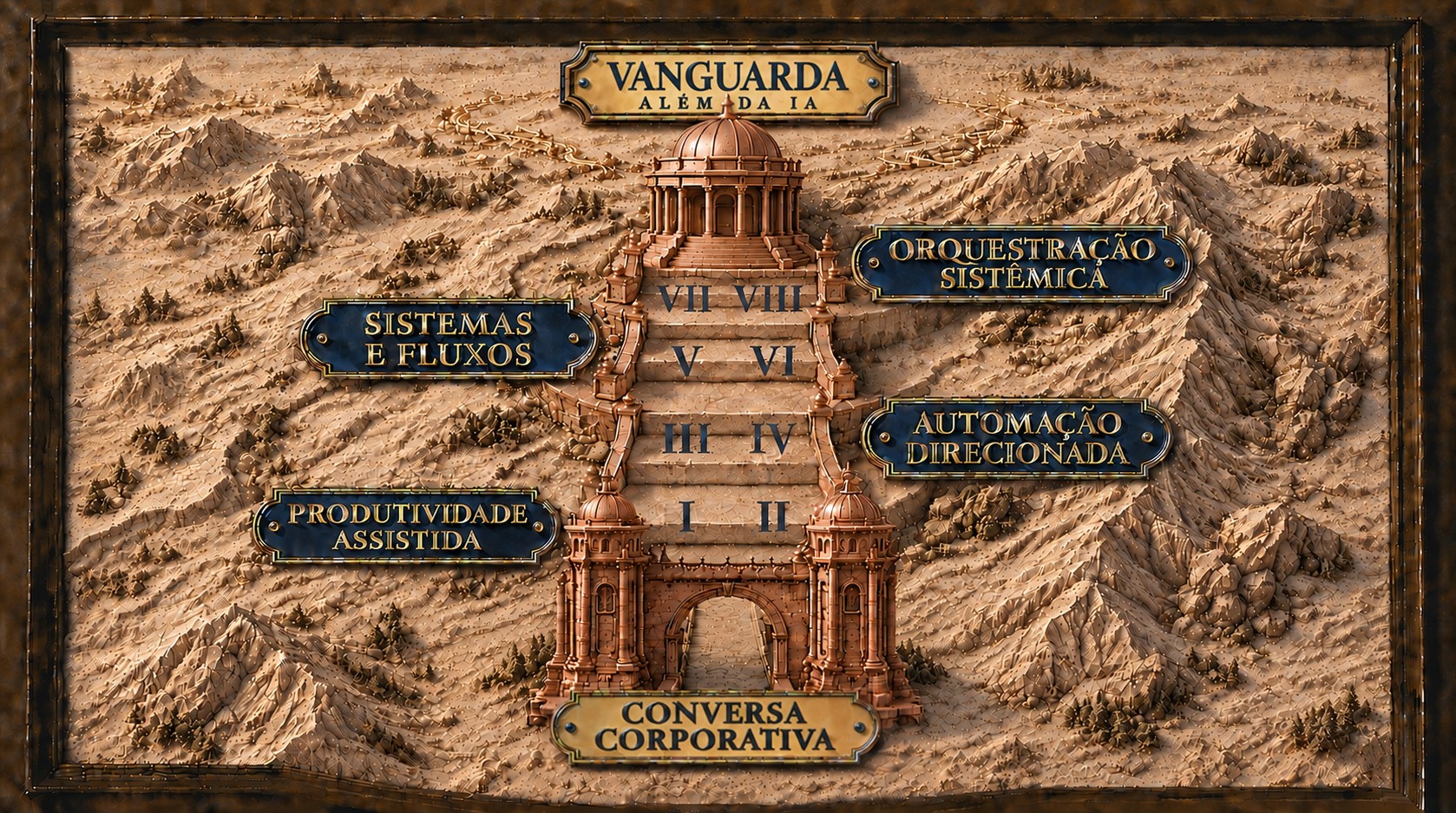
Relief map of the AI Judgment region: a staircase climbs from a building to the south, marked Corporate Conversation, past four terraces numbered in Roman numerals — Assisted Productivity, Directed Automation, Systems and Workflows, and Systemic Orchestration — up to the Vanguard marker, beyond AI, at the top, next to the temple crowning the climb
Entry the corporate conversation I–II Assisted Productivity III–IV Directed Automation V–VI Systems and Workflows VII–VIII Systemic Orchestration At the top Vanguard, beyond AI

"The question that decides isn't which tool to buy. It's how much decision-making can shift to happening without you, and what still needs to pass through you."

This question is executive, not technical. Whoever answers for the outcome answers for it before any specialist does, and answers with the information they have that day — which is rarely the information they'd like to have.

The executive deciding on this today doesn't need to learn how to build the system. They need judgment to evaluate what's presented to them, to know how far to let it go, and to hold the choice in front of whoever will hold them to it later.

That's the judgment this side of Prædictor builds. Not technical competence: decision-making capacity.

What shows up in practice

Four questions that reach the executive,
and none of them wait for you to be ready

These aren't classroom hypotheticals. They're the four that show up once an operation starts bringing in real agents, in the order they usually arrive.

01
The vendor

Evaluating what comes in

The company is being approached by partners selling AI, and they all make the same kind of promise. Without your own yardstick, comparison turns into personal preference, and the decision ends up going to the most insistent vendor.

02
The boundary

Building in-house or buying it in

The same capability can be built in-house or brought in, and both answers are defensible with the same slides. What separates one from the other is what the company needs to still know how to do three years from now.

03
The team

Leading people who work alongside an agent

The team is no longer only people. It changes who answers for the error, what gets evaluated as performance, and what each person understands they're no longer needed for. That last part doesn't get solved with a memo.

04
The process

Designing for an agent to execute

Automating the process that already exists just delivers the old process faster. Designing with the knowledge that an agent is the one executing is a different activity — and it's the one most organizations still don't know how to do.

"The right step isn't the highest one the technology can reach. It's the highest one the reach of its error can afford."

The market calls very different things "agents." The adoption scale we use separates eight steps, grouped into four classes, and measures one thing only: how much of the work still runs through a person.

It serves two conversations that today get stuck for lack of shared vocabulary. The first is internal: two departments say "we're going to use agents" and are talking about different steps. The second is with whoever's selling: the same term covers everything from the assistant that answers questions to the instance that coordinates an entire team of sub-agents, and the risk gap between the two extremes is total.

See the full scale

The eight levels, the four classes, and the reach yardstick are published on the method page, with dates and sources.
For companies

The executive program, in four modules

Built for a leadership group to decide with the same judgment, instead of each person with their own. The last three modules attack the questions above directly; the first delivers the shared foundation all of them assume: a common vocabulary to compare against. None of them end in notes — they end in a filled-out artifact built on a case from the company's own operation.

I
Module 1

Literacy and judgment

What separates rule-based automation, assistance, and agents, and what you can expect from each. Closes with the adoption scale applied to processes the group itself chooses.

II
Module 2

Evaluating what comes in

A governance checklist to hold up against any vendor proposal: what they need to prove, what they tend not to say, and what stays with the company when the partnership ends.

III
Module 3

Leading the hybrid team

Who answers for the agent's error, what starts getting evaluated as performance, and the recontracting conversation with someone who feels they're no longer what they used to be. Done with the person present, not about them.

IV
Module 4

Designing for agents

A four-step exercise that takes a real process from the company and redesigns it to be executed by an agent, with the autonomy ceiling and the checkpoint defined right there, on paper.

There's also a six-hour deep-dive format, for when the group needs to leave with one in-house case solved end to end, instead of four started. The scope, calendar, and format come from the situation the company brings.

See the full program Talk about the program

For those deciding alone

Not every decision comes with a team behind it

A good part of the people who land here aren't buying a program for a group: they have a decision on the table, alone, and need a yardstick for it. There's no closed individual track for that, and we're not going to announce one that doesn't exist. There are three open doors today, and a conversation.

Half-day, cohort-based

Executive Judgment Masterclass

The adoption scale and the reach yardstick applied to a case you bring. You leave with the filled-out artifact, not with the slide deck.

See the masterclass
120 minutes, live

Webinars

A decision leadership teams usually make without a yardstick, per session. Every number cited comes with who measured it and who paid for it.

See the live webinar
Reading

Articles and e-books

The series on AI adoption is published and free. The e-books cover the move into leadership, with a verifiable public case per chapter.

Read the series
The fourth door

The decision you have right now

If what's on your table doesn't fit any of the three, write in describing the situation. If there's something that can be built from what already exists, I'll tell you what it is. If there isn't, I'll tell you that too.

Describe the situation
Not quite this?

This page is about deciding on AI. If your situation is different: