You approve what you can't examine, lead a team that's no longer only people, and answer for a result that depends on a machine you didn't build.
The diagnosis on AI has already been made by five consulting firms. What none of them tells you is what you decide on Monday.
The competence that got you here has stopped being the one that keeps you here.
Not because you got worse. Because what your competence used to produce stopped being scarce — and what's abundant doesn't sustain position.
On the AI front: roughly 85% of companies have already given agents the power to decide without having the control in place for it. In 6 to 12 months, they multiply beyond control. In management: between 2022 and 2025, the number of managers fell 6.1%, middle-management openings shrank 42%, and span of control doubled, from three direct reports to six.
You're not the one who became dispensable. What AI started doing on its own is what used to set you apart.
What no system has absorbed is judgment: deciding with incomplete and conflicting information, defining safe governance, holding a position against someone who disagrees and knows more of the technical detail, answering for what goes wrong. No system signs its name to it.
This is the decision Prædictor is about.
In classical Latin, the one who reads the signs of the moment and anticipates tomorrow through the wisdom of experience is the Prædictor.
That's what you're about to become.When the signature stops being an exam, it becomes the appearance of control. And on the day of the incident, the name on the approval is yours.
The decision about AI is executive before it's technical. What's missing is a yardstick to evaluate what's presented, and to hold the choice afterward.
That's how you used to prove your value to move up. Profitable companies are already removing that layer — and it's not a cost cut: it's that the layer got expensive for what it delivers.
Maturity report, industry benchmark, readiness index. They all tell you where your company stands.
Govern before you scale. Redesign before you buy. Name an owner. All correct, and all at the level of principle.
How far can this specific process run on its own? What control is left on my side? Who answers when it gets it wrong? This is the decision Prædictor is about.

Technology changed the condition. The judgment behind the decision didn't.
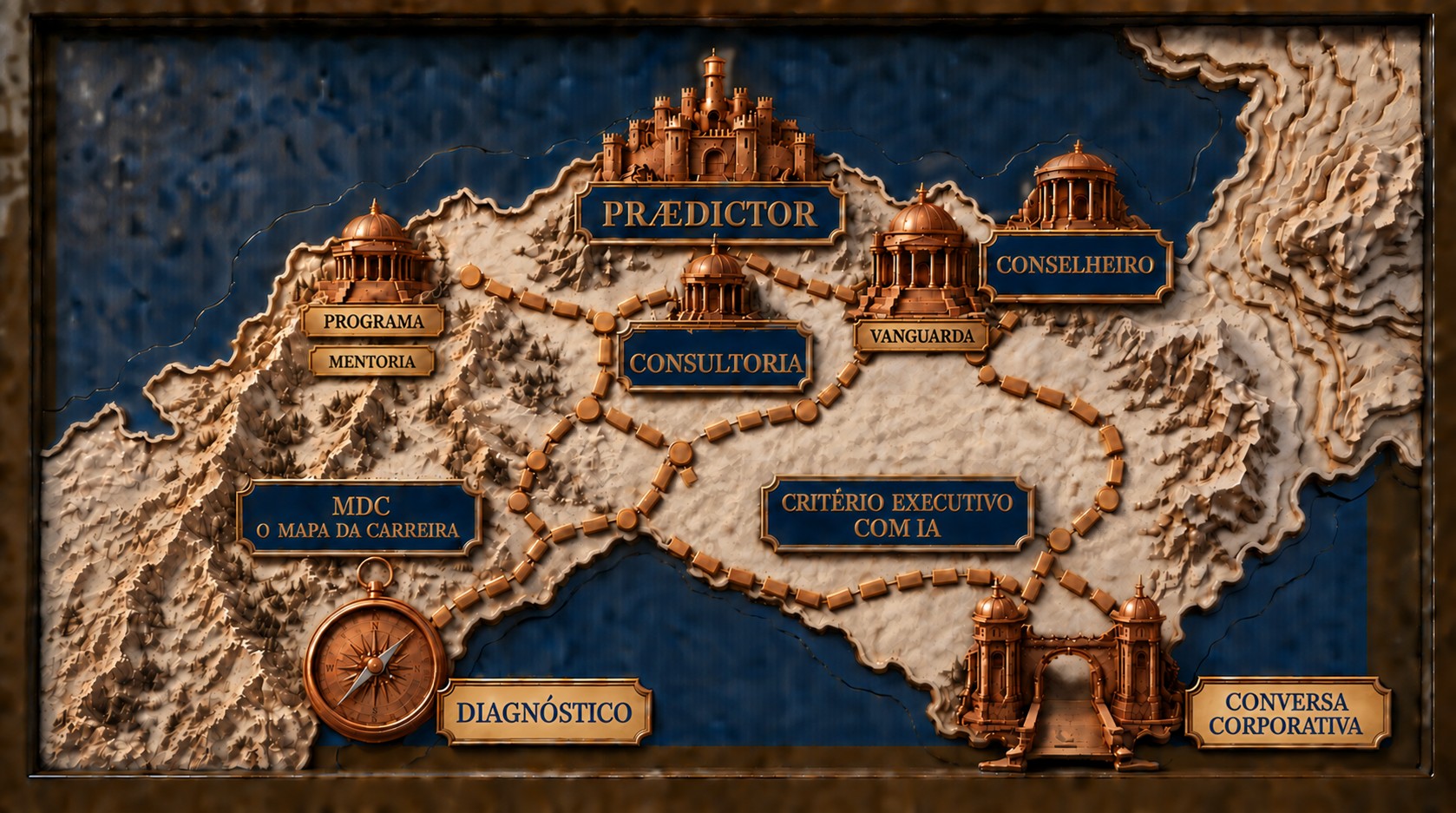
Each family answers a different question, and all of them rest on the same method. Two doors lead into the territory: a free diagnostic, for those arriving on their own, and a conversation, for those arriving through their company.
For the executive, on their own. A career trajectory, walked over time.
For the company, with a group. A decision-making capability, installed within a set window of time.
Webinar, masterclass, and program show up in both columns, and it's not repetition: it's the same material, in two different orders. What changes is who buys it, what comes before it, and what's expected after.
Built to measure: the scope comes from the situation you bring.
Seven situations, in the voice of the person arriving. Find yours, and what comes next is already decided.
The repertoire that carried your whole career stops being enough exactly when the demands go up. It has a name, a cause, and a path.
Start with the DiagnosticDelivery isn't what's holding you back. What's holding you back usually sits on one of two axes, and the first step is finding out which.
Start with the DiagnosticThe decision is executive before it's technical. What's missing isn't learning to build: it's a yardstick to evaluate what gets presented, and to hold the choice afterward.
See AI JudgmentIt changes who answers for the error, what gets evaluated as performance, and what each person understands they're no longer needed for.
See the executive programThey all make the same kind of promise. Without your own yardstick, comparison turns into preference, and the decision ends up going to whoever's most insistent.
See how to evaluate what comes inEvaluating from outside, without operating from within, calls for different questions than the ones an operator asks. There's no off-the-shelf format for this: there's a conversation.
Let's talkIt's not training or consulting: it's someone who's already sat in that chair, available for the specific decision that's open right now.
Let's talkEach one takes a specific pain point of the move into leadership and shows what to do about it: a verifiable public case per chapter, a proprietary concept that organizes the reading, and three supporting materials to apply it.
The first 30 days in a new role define how you'll be seen for years afterward. What to do, and what to avoid, in that window that never comes back.
See the e-bookFor those who deliver well and want to decide. The move from someone who executes to someone who answers for the outcome, and what changes on every front.
See the e-bookOn the ladder above, you pick a step. Here there's no step: the scope comes from the situation you bring, which is why there's no list price.
Every change in a company demands a change from whoever leads it. From a challenge that starts in one executive's chair to one that runs through the whole organization, Prædictor steps in where there's no ready-made solution: structures the decision, runs the project, and carries the change through to operation. Leading the work is someone who has already sat in that chair and led change in large operations, so the result works and the capability stays.
Let's talkA board seat or an advisory seat. For companies that want, at the table, someone who has already made technology decisions with the outcome carrying their own name — not just someone who offered an opinion on it. Scope, format, and frequency get defined in the conversation.
Let's talkSeveral industry outlets sought him out as a source, always named and quoted directly: critical network reliability in 2002 and 2003, decision-making under ambiguous authority in 2005, and data center energy efficiency in 2016 — a decade before the subject became a headline. The subject changed. The invitation didn't.
Via Embratel · Executivos Financeiros · INFO Corporate · IT ForumRecognition from CIONET, a community of technology leaders, decided by peers. The same year, Top 50 Executives in Artificial Intelligence, by 7th Experience.
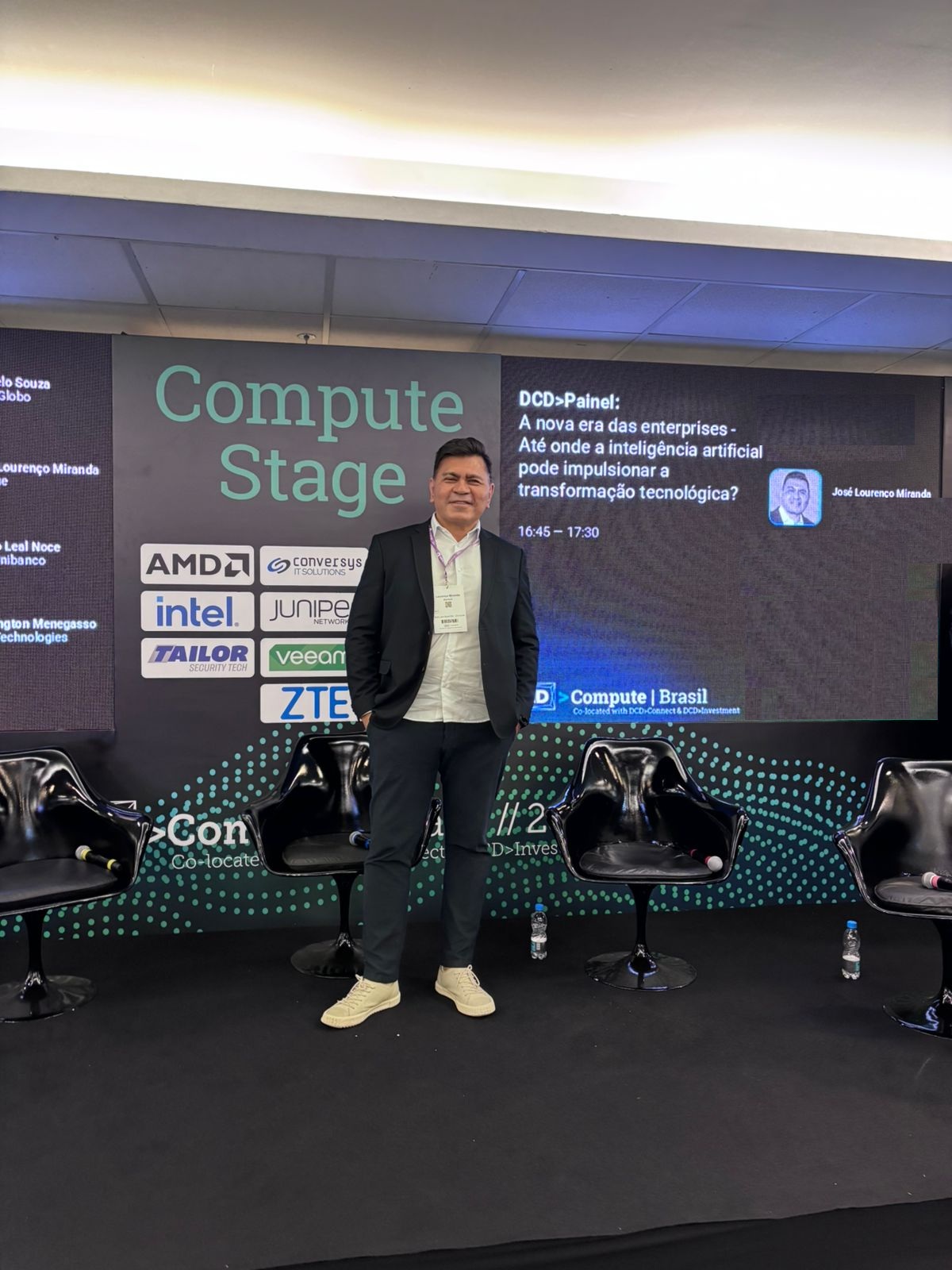
CIONET · 7th ExperiencePanelist at The Tech Summit, in May 2026, on Technology Modernization as a Strategic Lever. At DCD>Brazil, in November 2025, on The new era of enterprises: how far can AI drive technology transformation? And at Cidade Empreende, in São José dos Campos, in April 2025, on Data and AI: Smart Decisions for the Future.
The Tech Summit · DCD>Brazil · Cidade EmpreendeEpisode 48 of the Jump podcast, How is Kenvue leading digital transformation with technology and AI?, in the seat of CTO for Latin America. An hour of public, dated commentary on technology decision-making — including what you do when the error can't be undone.
Jump Talk #48The future isn't waited for. It's anticipated.
The Diagnostic is free, fifteen questions, and returns your position on two axes. If it says you don't need any development program, that's what the screen will say.