About

Lourenço Miranda

Forty years in the executive chair at IBM, Mastercard, Johnson & Johnson, and Kenvue — the last eight as CTO for Latin America. The Prædictor method didn't come from a classroom: it came from deciding, with incomplete information, things that couldn't be undone.

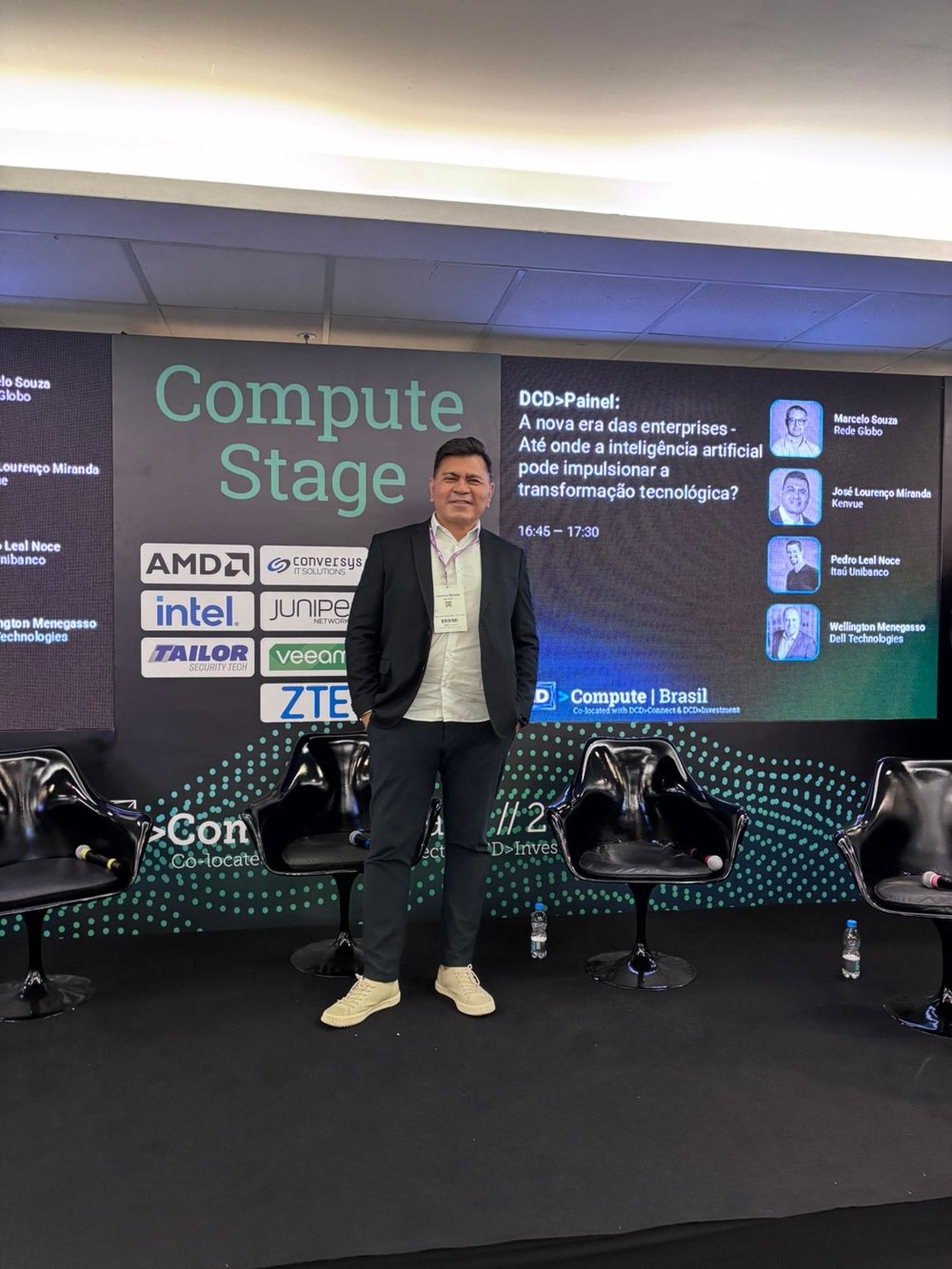
Lourenço Miranda on stage at DCD>Brazil, November 2025, in front of the panel announcing the debate on how far artificial intelligence can drive technology transformation.
DCD>Brazil, November 2025. Panel on the limits of artificial intelligence in corporate infrastructure, alongside executives from Rede Globo, Itaú Unibanco, and Dell Technologies.
Why this matters here

The yardstick didn't come from a framework. It came from the chair.

The central question of the method — what's the worst that happens if this goes wrong, and can it be undone? — wasn't written for a course. It's the question he already used to decide his own career, decades before AI governance existed.

01
What's specific about the track record

Irreversible decisions, made repeatedly

In 2005, ambiguous authority had a face: two bosses, and you could negotiate with both. Today it has no face at all — and when it isn't written down who answers for what the machine produces, responsibility migrates on its own to the last human in the chain.

02
What it doesn't have

A content-first career

There's no track record built on stage first and then sold as a method. The path ran the other way: forty years signing off on decisions, and only then the decision to systematize what separated the ones that worked from the ones that didn't.

This yardstick didn't appear on its own: it comes from a set of beliefs about decision-making, error, and accountability.

Read the Prædictor philosophy

What forty years didn't numb

"Making hard decisions and letting people go isn't easy — I lose sleep over it, and I hope I keep losing sleep over it, because it's a sign I'm still human."

Lourenço Miranda · Jump Talk #48, November 2025
The track record

Four companies, the same kind of problem

1986 — 1996 · IBM
Engineering, research and development

Started in manufacturing and product engineering in Hortolândia, São Paulo, doing failure analysis on storage subsystems. Early in his career, a sixteen-month international assignment at IBM's lab in San Jose, California, working on digital servo development.

Afterward, the technology center in Brazil, and a stretch at the Hursley lab in the UK, as the liaison between the Brazilian operation and development there. That's where he learned the difference between what a technology promises in the lab and what it delivers in the field — a distinction that's still at the core of the work today.

1999 — 2012 · Mastercard
From Network Manager to Head of IT & Network Services

Joined the first team put together to stand up Mastercard's operation in Brazil, when there was a single connected client site. By the time he left the regional role, there were more than forty sites across the country.

Between 2000 and 2006, he was Mastercard Brazil's spokesperson to trade press and industry events, with four named talks and interviews in industry magazines. He moved up to Network Services Director in 2003 and, in 2007, to Head of IT & Network Services for Latin America, relocating to Miami in January 2008. In that role he led a regional network migration spanning one hundred and eighty-one sites — the kind of project with no window to try again.

2014 — 2022 · Johnson & Johnson
From Senior IT Director, Infrastructure Services, to CTO Latin America

Came in to fix a regional infrastructure that no longer supported the operation, under the constraint that makes this kind of work hard: the fix couldn't stop what was already running. Remediating what was broken, changing out teams where teams needed changing, and putting governance over a portfolio that until then ran without it. How the teams worked changed along with it, with Agile, Lean, and Design Thinking installed across the region.

In 2018 he also took on applications, and the decision was to stop running the two as separate organizations: infrastructure, applications, and IT services began answering as a single function, serving commercial operations and the supply chain across Latin America.

This period produced the modular data center in São José dos Campos, designed to reduce technical debt and support manufacturing, lab work, logistics, and serialization across the region. It got trade-press coverage in 2016, with him quoted on innovation and energy efficiency — a decade before technology's energy footprint became a board-level topic.

2022 — 2026 · Kenvue
CTO Latin America

Led the region's technology through one of the largest recent corporate separations, without interrupting operations. Splitting two companies that shared everything is the hardest exercise in irreversible decision-making there is: every system switched off on the wrong day is revenue that doesn't come back.

2026 — Prædictor
Founder

Prædictor was born from a simple observation: the most expensive decisions he watched go wrong didn't fail for lack of technology or lack of good people. They failed because nobody had defined, beforehand, how far the machine could go and who would answer when it got it wrong.
Public record

What you can verify

Peer recognition and press coverage, with a name and a date. None of it is self-reported.

2025

Top 10 CTO of the Year

Recognition from CIONET, a community of technology leaders, decided by peers — the one kind of recognition that's hard to fabricate.

2025

Top 50 in Artificial Intelligence

Among the top fifty standout AI executives, by 7th Experience.

November 2025

Podcast

Episode 48 of the Jump podcast (watch), in the seat of CTO for Latin America. An hour of public, dated commentary on technology decision-making — including what you do when the error can't be undone.

2002 — 2016

Quoted in trade press

Several industry outlets sought him out as a source. Always named, and quoted directly.
Via Embratel, cover story, October 2002, and Executivos Financeiros, May 2003: critical network reliability and why a domestic transaction never leaves the country.
INFO Corporate, the CIO magazine, May 2005: how to decide when two authorities give orders at the same time.
IT Forum, June 13, 2016: the modular data center Johnson & Johnson built in São José dos Campos, with him speaking about energy efficiency a decade before the subject became a headline.
The subject changed. The invitation didn't.

Stage

Industry panels and talks

The Tech Summit, May 2026: Technology Modernization as a Strategic Lever.
DCD>Brazil, Data Center Dynamics, November 2025: The new era of enterprises: how far can AI drive technology transformation?
Cidade Empreende, São José dos Campos, April 2025: Data and AI: Smart Decisions for the Future.

What he writes

The track record becomes public text

The record above is what others have said. This is what he produces today, with a source and a date — and it's where the yardstick shows up applied to a concrete case.

Article · August 5, 2026

What isn't written becomes personal

The company that invested the most in AI climbed the ladder, hit the ceiling, and turned back: it shut off the usage dashboard and moved human approval back to the middle of the chain. What that teaches about where the right step actually is.

Read the article →

See all articles

The name

A two-thousand-year-old word

Prædictor isn't a made-up name: it's a real Latin word. It comes from praedicere: prae, before, plus dicere, to say, to proclaim.

It literally means "the one who says beforehand" — the one who states what hasn't happened yet. Someone who sees ahead.

The origin

The language of those who governed the world already had the word

There was a name for someone who saw ahead, because the function existed, and was recognized. What the word describes isn't a gift: it's a reading of signals, learned by watching the landscape before it closes.

Why it became the company's name

Anticipating was the job, before it became a method

Forty years anticipating technology change inside four corporations, and then the decision to systematize what separated the decisions that worked from the ones that didn't. Prædictor was born from that experience, so that seeing ahead stops being the talent of a few and becomes a method. The name describes what's practiced there, not a brand aspiration.

The track record matters for what it became.

What's left of forty years signing off on decisions is a yardstick that answers case by case. It's published, in full, and it costs nothing to read.

Read the method
Where to go from here
What exists today programs, masterclasses, webinars